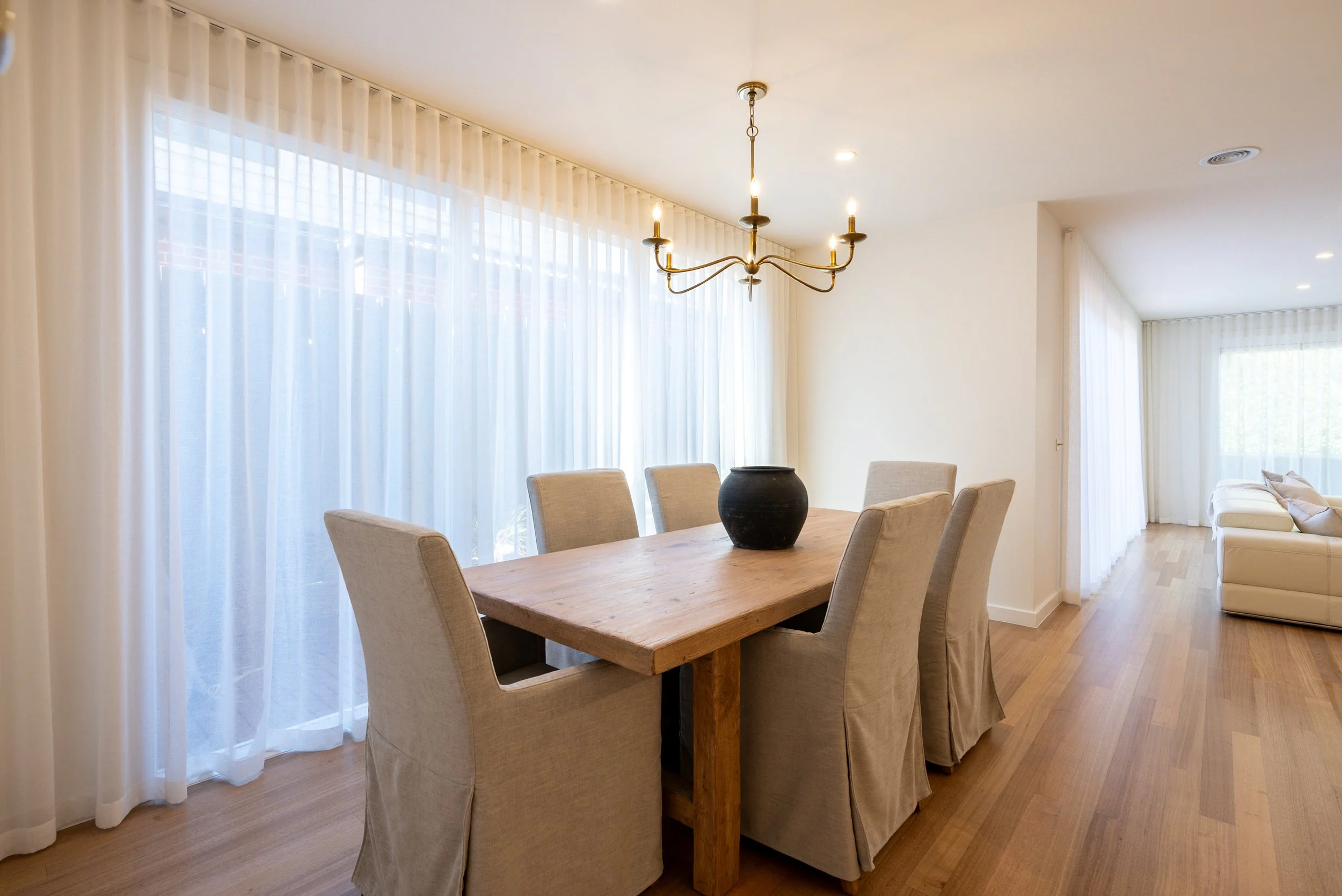
Custom sheer curtains installed by Evans Curtains and Blinds across two adjoining living room windows. The full-height treatment provides daytime screening, filters natural light and creates a consistent finish around the corner of the room.
Choosing new window furnishings can feel like it begins with products. Curtains or blinds? Sheer or blockout? Manual or motorised? Plain or patterned?
In our experience, those decisions become much easier once we understand what you need the room to do.
You do not need to arrive at a consultation knowing the name of every fabric or the difference between each curtain heading. That is what we are here to help with. What is far more useful is having a clear sense of how you use the room, what is currently not working and what matters most to you.
Before meeting with Evans Curtains and Blinds, these are some of the questions worth considering.
1. What are you trying to achieve in the room?
Sometimes the purpose is primarily decorative. A room may feel unfinished, the proportions may seem slightly off or the existing window furnishings may no longer suit the rest of the home.
In other rooms, the practical requirements lead the conversation. You may need privacy from a neighbouring property, protection from afternoon sun, better light control in a bedroom or a more convenient way to operate a difficult window.
Try to begin with the problem rather than the product.
Instead of deciding that you need roller blinds, for example, tell us that the room becomes uncomfortably bright in the afternoon but you still want to preserve the view. Rather than assuming you need blockout curtains, explain that streetlights are disturbing your sleep.
Once we understand the outcome you want, we can recommend the product, fabric and fitting method most likely to achieve it.
2. How much light can you comfortably live with?
“Blockout” can mean very different things to different people.
Some people prefer to wake naturally with daylight entering the room. Others are highly sensitive to even a small glow around the edges of a blind. Shift workers, young children and light sleepers may need a much higher level of darkness than someone furnishing a guest bedroom.
This is worth being very specific about during your consultation because no window furnishing exists independently of the space around it. Light can enter above, below and around the sides, even when the fabric itself is described as blockout.
The fitting method matters. A roller blind installed inside a window recess will usually leave more visible light around its edges than one mounted over the architrave. Curtains may need generous width and overlap, sufficient length and, in some situations, a pelmet to reduce light entering from above. Where near-complete darkness is essential, specialised side channels may also need to be considered.
These solutions can look and perform differently, so the right recommendation depends on both your expectations and the appearance you want to maintain.
3. What level of privacy do you need during the day and at night?
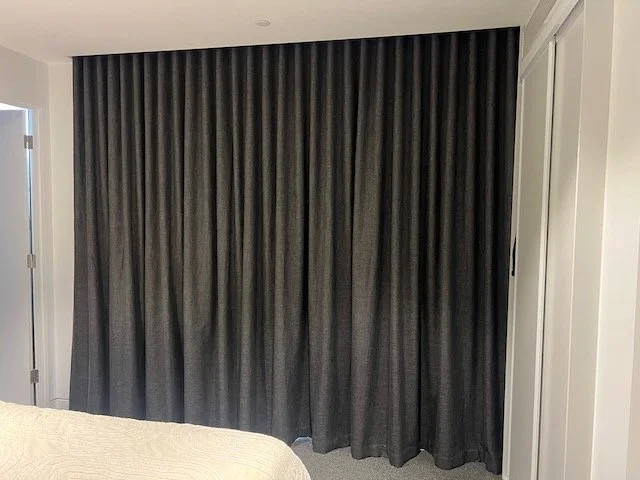
Dark full-length bedroom curtains installed by Evans Curtains and Blinds. This image demonstrates how generous coverage and considered placement can help manage incoming light while giving the room a finished appearance.
Privacy is not always a simple choice between open and closed.
A street-facing living room may need daytime privacy without losing natural light. A bathroom requires a different level of screening, while a bedroom may need one solution during the day and another at night.
Sheer curtains are often chosen because they soften the room and provide a degree of daytime screening. However, their effectiveness changes with lighting conditions. Once the interior is brighter than the exterior at night, visibility through a sheer can increase.
If privacy is important, consider when you need it, what can currently be seen from outside and whether you still want to retain light or a view. A layered solution, such as sheers with a separate blind or lined curtain, may provide more flexibility than relying on one product to do everything.
4. How will you use the window furnishings each day?
A window furnishing should suit the way the room is actually used, not just how it looks when it is first installed.
Think about which curtains or blinds you will open and close every day, which will remain in one position most of the time and whether any windows are difficult to reach. This helps us recommend operating systems that are practical without adding unnecessary complexity.
Motorisation can be extremely useful for frequently operated blinds, large or high windows and situations where cords or chains would be awkward. It may also make operation easier for someone with reduced hand, wrist or arm strength.
That does not mean every window needs to be motorised. In many homes, it makes more sense to prioritise the products used every morning and evening, then keep less frequently adjusted window furnishings manual. Those savings can then be directed towards the rooms, fabrics or features that will make a greater difference.
5. Who uses the room?
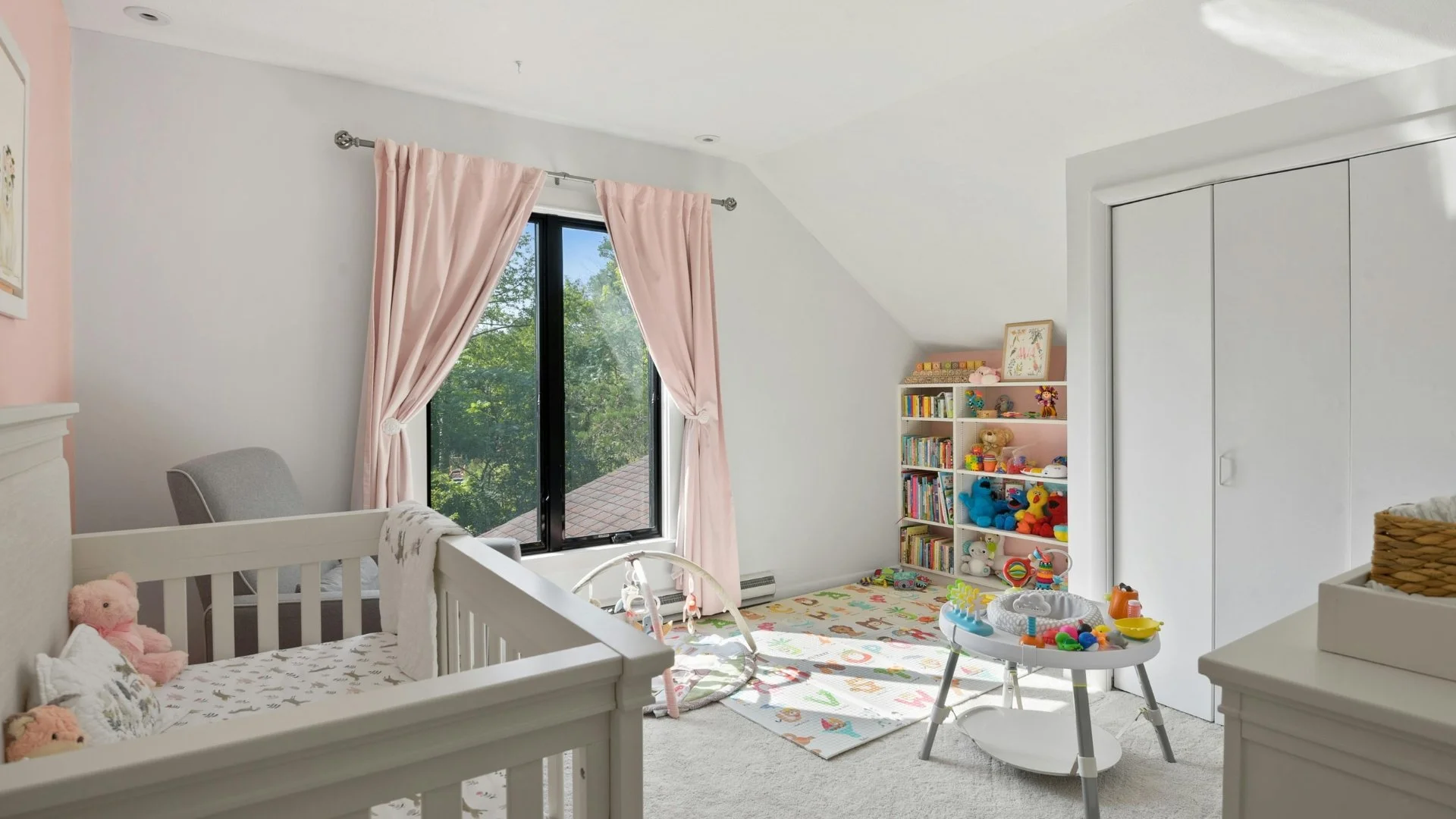
A reference image of a bright children’s bedroom with pale pink curtains, a cot and a dedicated play area. Used to illustrate why children, pets and everyday room use should be considered when choosing curtains or blinds.
Children, pets, overnight guests and family members with mobility or sensory needs can all influence the most suitable solution.
A fabric that works beautifully in a formal sitting room may not be the most practical choice beside a busy family area. Long curtains may need to be considered differently in a room where a pet sleeps near the window. Chains and cords may be inconvenient for someone with limited strength or dexterity.
These details are not secondary. They help us consider fabric durability, operating methods, placement and ease of maintenance from the beginning.
The more we understand about daily life in the room, the more useful and realistic our recommendations can be.
6. What else is changing in the space?
If you are renovating, it is helpful to tell us what has already been completed and what is still to come.
Flooring, cabinetry, paint colours, furniture placement and structural work can all affect the final result. New carpet can change a curtain drop. Built-in cabinetry may reduce the available stackback beside a window. A change in wall colour may alter the way a fabric looks in the room.
It is often beneficial to begin the conversation early, particularly when window furnishings need to coordinate with a builder, interior designer or electrician. Early planning can identify opportunities for ceiling-mounted tracks, recessed pelmets, concealed blinds, additional wall support or wired motorisation before those decisions become difficult and expensive to change.
The final measure, however, should happen at the appropriate stage of the project, once the relevant surfaces and structures are settled. Starting early does not mean rushing production. It means allowing enough time to plan properly.
7. What is your budget, and where will it have the most impact?
You do not need to know exactly what every product should cost before your consultation. It is still helpful to have an overall investment range in mind, especially if you are furnishing several rooms.
A whole home does not necessarily need the same solution at every window. Bedrooms may require stronger light control, living areas may benefit from sheers and rooms used less frequently may only need a simple, practical treatment.
Understanding your priorities allows us to discuss where it is worth investing and where a more straightforward option will perform perfectly well. It can also help you decide whether to complete the home at once or work through it in considered stages.
You do not need to have all the answers
A consultation should not feel like a test of how much you know about curtains and blinds.
Bring photographs, plans, inspiration images or fabric samples if you have them, but do not worry if you are still uncertain about the product itself. Start by thinking about the room: how it is used, what is not working and what you would like to feel different once the window furnishings are installed.
From there, we can help you compare the practical and visual options, explain the trade-offs and find a solution that suits your home rather than simply following a trend.
If you are considering new curtains or blinds, contact Evans Curtains and Blinds to begin the conversation.
Contact Evans Curtains & Blinds or call 1300 304 347.