How daily routines, accessibility and the scale of a project shape the right motorised curtain or blind system.
Customers often ask us whether motorisation is worth adding to their curtains or blinds.
The answer depends on the job the motor needs to do.
In a bedroom, motorisation removes the need to move a sheer curtain twice a day to reach the blind behind it. For someone experiencing reduced strength, it makes a heavy curtain easier to operate. Across a large home, it provides a practical way to control numerous blinds without visiting every window individually.
Each situation requires a different level of motorisation.
Making a daily bedroom routine easier
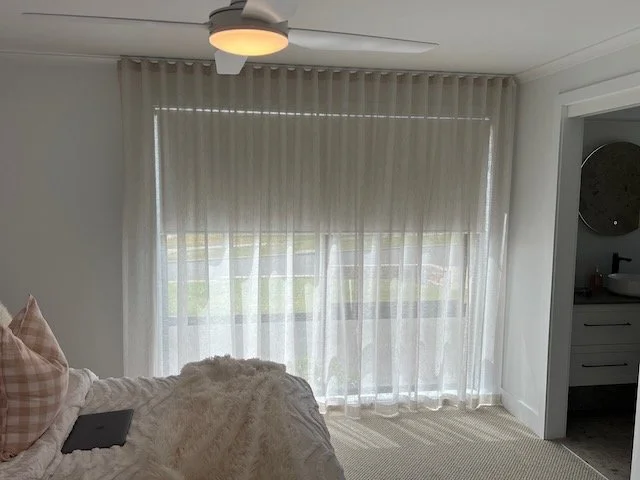
A blockout roller blind is often installed behind a sheer curtain in a bedroom.
The sheer remains closed during the day for privacy, while the blockout blind is raised each morning and lowered at night. With a manual blind, the customer needs to move the sheer every time they reach for the chain.
Motorising the roller blind allows it to operate while the sheer remains in place. This reduces handling of the fabric and removes an awkward task from the customer’s daily routine.
For this arrangement, a simple remote or wall control is all you need. I’d start with how you want to use the blind, then choose controls that make that task easy.
Adapting as the customer’s needs change
We worked with an older couple who were finding their existing curtain increasingly difficult to operate because of reduced strength in their wrists and arms.
Our first recommendation was to change the track and cord the curtain from both ends. Dividing the operation between the two sides made it lighter and more manageable.
Around 18 months later, they contacted us again. Their needs had changed, and manual operation was becoming uncomfortable even with the modified track. They decided to motorise the curtain.
What stayed with me about this project was that the right recommendation changed over time. The track adjustment helped initially. When it was no longer enough, motorisation became the appropriate next step.
If you’re finding a curtain difficult to pull, or a blind awkward to reach, tell us during the consultation. It helps us assess the track, controls and whether the product should allow for motorisation later.
Coordinating motorisation throughout a home
We also completed a large family home with approximately 26 motorised Roman blinds, along with additional curtains.
At that scale, choosing the motors is only one part of the job. The household needs a clear way to control everything: which blinds move together, which rooms remain separate and how each group is identified.
The control plan should follow the way you use your home. You might want to open several living-area blinds together while keeping bedroom controls separate. Where compatible, app controls and scheduled routines offer further options.
I also want customers to know what happens after installation. If a remote is accidentally reprogrammed, an app stops connecting or you want to add another blind, you need someone who understands the system and can help.
What needs to be decided before ordering?
The finished weight
The motor must suit the completed curtain or blind.
Window size, fabric weight and distance of travel determine the motor and hardware required. Full-height lined curtains need particular care because fabric, lining and fullness add considerable weight across a wide opening.
We specify the motor, track and window furnishing together so every component suits the finished product.
Battery or fixed power
Rechargeable motors suit many existing homes where adding fixed electrical wiring would involve unnecessary and expensive building work.
But think about how you’ll charge them. If the blind is several metres above the floor, access to the charging point needs to be considered before choosing the system.
Hardwired systems are commonly planned during new builds and substantial renovations. Power and cable positions should be confirmed before the walls and ceilings are completed. Fixed electrical installation work in Victoria must be completed by a licensed electrician.
Some compatible existing roller blinds are also suitable for a motorisation upgrade. This depends on the roller tube, fabric weight, hardware and condition of the blind.
The controls
A remote, wall control or connected system should suit the person using it. With several blinds, clearly organised groups and channels help everyone understand what each button operates.
Before we leave, you should feel confident using the controls and know where to turn for help with programming or future additions.
Ongoing support
A motorised system will occasionally need assistance with controls, programming or future additions.
Before choosing a system, confirm who will program it, explain the controls and provide support after installation.
Questions to answer before choosing motorisation
Who will operate the curtain or blind?
How often will it move?
Is it difficult to reach or physically uncomfortable to operate?
Will one product move or several?
Is rechargeable or hardwired power more practical?
Which control method will the household use confidently?
Who will provide programming and ongoing support?
You don’t need to arrive knowing which motor or system to choose. Explaining what you want to make easier gives us a useful starting point.
Considering motorised curtains or blinds?
Evans Curtains and Blinds can assess how each room is used and recommend a motorised system suited to the window furnishing, household and scale of the project.
Talk to Evans Curtains and Blinds about your home.
References
Somfy Australia, Motorised systems and controls for interior blinds:
https://www.somfy.com.au/products/interior-blinds/Energy Safe Victoria, Electrical workers: https://www.energysafe.vic.gov.au/community-safety/working-tradespeople/electrical-workers
Somfy Australia, Motorising existing blinds in Australia:
https://www.somfy.com.au/discover-somfy/blog/post/motorising-existing-blinds-in-australia-can-your-blinds-be-retrofitted