
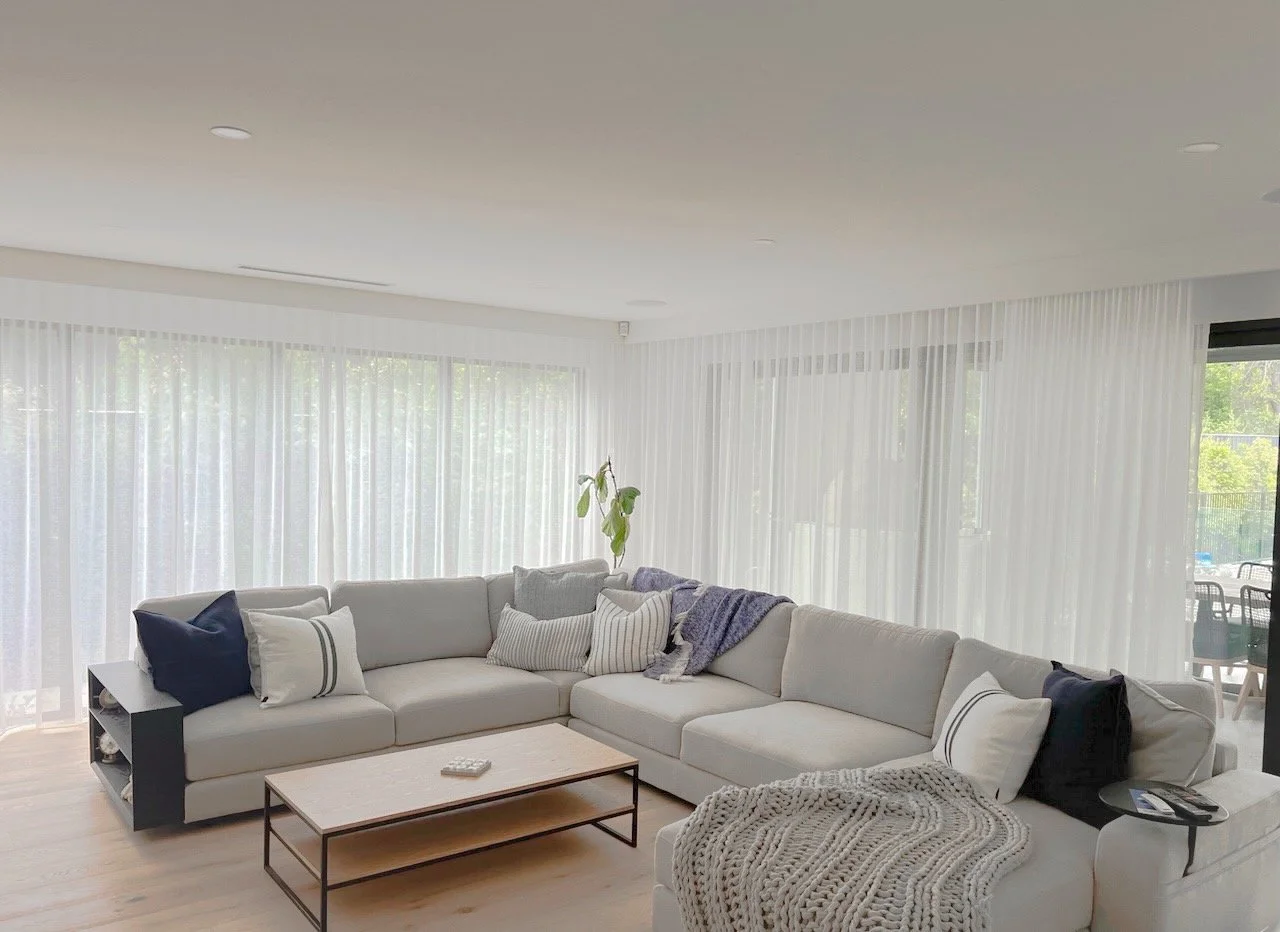
Curtain Installation
It’s all about location, location…
Beautiful custom made curtains evoke images of co-ordinated colour schemes, stunning fabrics, and long flowing drapes which bring a sense of identity to a space. It could be sheer curtains puddling slightly on the floor to offer the room a relaxed feel, or a more traditional pleated curtain offering a level of formal sophistication and style.
One aspect of custom made curtains that we often see being overlooked, or not being fully considered, is the installation, and in particular where exactly the curtain is fitted.
Where the curtain and track are installed will have a huge impact on the end result both aesthetically and practically.
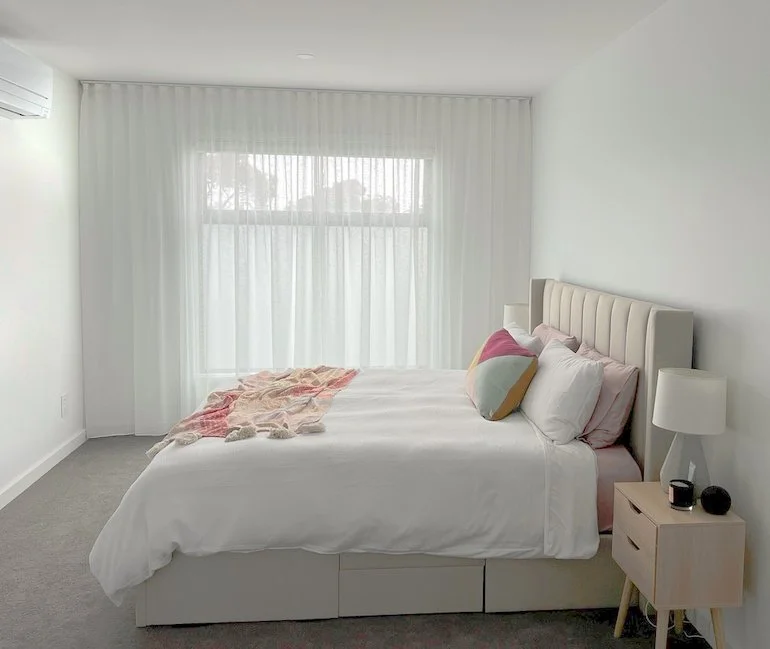
TOP FIX
Maximum height. Maximum impact
The term ‘top fix’ means attaching the track to the surface directly above it. This could be to a ceiling, an upholsted pelmet, or the underside of a recessed pelmet.
Top fixing provides a clean look which minimises the visability of the track and brackets. It enables the curtain to hang fully from floor to ceiling, helping to elongate the room and create a soft yet dramatic feel.
We would generally only recommend top fixing if the ceiling is square set, as oppose to having a cornice running around the room. A cornice would push the track further into the room requiring more floor space for the curtain to hang, and would result in a gap when fitting upto an adjacent wall.
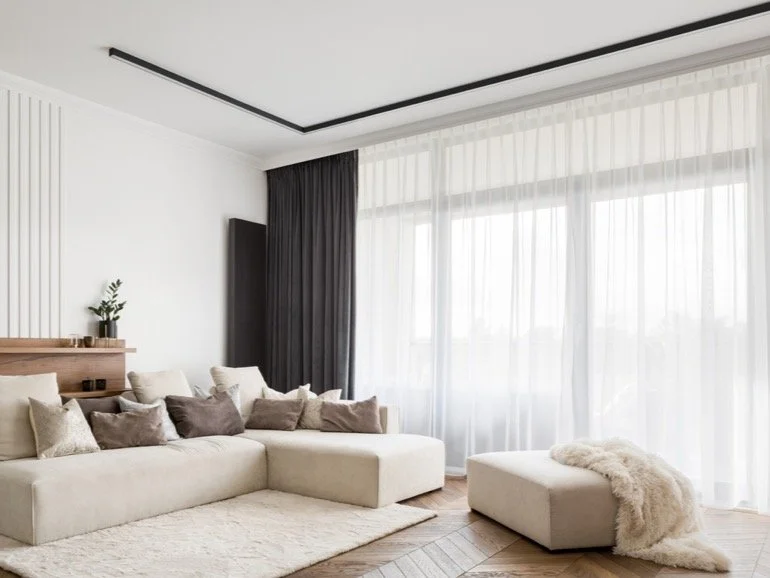
FACE FIX
Completely customisable
A face fix track is mounted directly to the wall or architrave using a series of brackets. This enables us to customise the height of the finished curtain to give the best result. We generally adopt two approaches when face fitting.
The first approach is similar to top fixing, in that the aim is to set the curtain and track as high as possible to elongate the space. We would recommend fitting the track direcly under the cornice to achieve this. If there is no cornice in place, we would suggest top fixing to the ceiling.
The second approach is used when a Designer or Feature track is to be utilised. In this instance the track itself is an integral part of the overall look. Fitting the track directly under a cornice would not make best the best use of the track visually, and fitting directly to the architrave could make the curtain and room appear ‘stubby’ (depending on the type and style of window). We would generally choose a point between the architrave and cornice to highlight the design elements of the track, whilst maximising the curtain drop. It’s also important to take cues from other features, structural lines and aspects of the room when finalising this height.

STACK BACK
Maximise the light
Stack back is a term used to describe the amount of room that the curtain will take up when pulled back to its open position. If sufficient space is not allowed beyond the window opening, once the installation is complete, the curtain will cover too much of the window when opened and hence reduce the light coming into the room.
To prevent this, curtains and tracks should be made and installed wider than the window opening. Stack back is particularly important when curtains are being fitted over a patio or sliding doors. If there is insufficient stack back, the curtain could get caught in the door when it’s opened and closed, resulting in it becoming damaged or dirty.
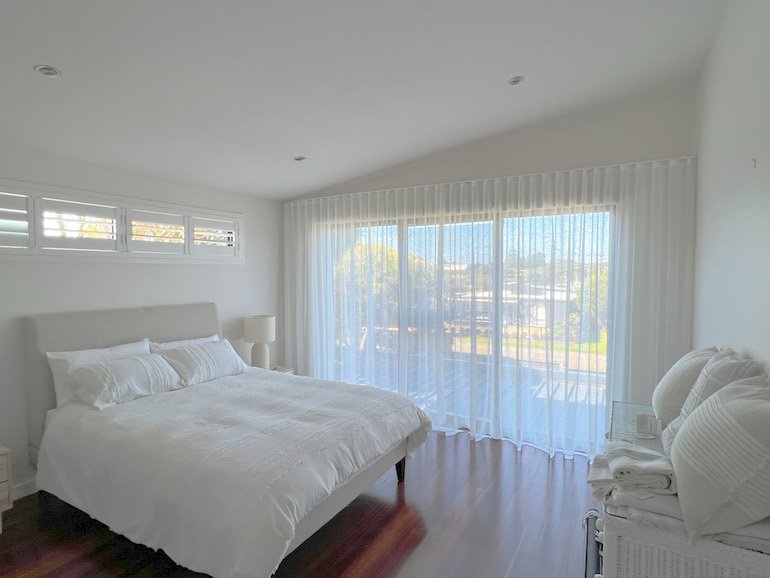
WALL TO WALL
Use it or lose it
Sometimes once the allowance has been made for suffiicient stack back, there may only be a small amout of wall space left between the start of the curtain and the adjacent wall.
If there is no specific purpose for the space, or it is too small to be functional, it may be best to lose it, and extend the curtain all the way wall to wall.
This gives a dramatic feel to a space, creating a beautiful, relaxing haven that instantly softens the space as the farbic texture fills the whole wall.
EXPERIENCE
We’re here to help
We’ve been creating custom curtains in Melbourne since 1978, so you can be confident in our knowledge and experience. We will guide you through the design process, looking at all the factors to be considered, so that we can best advise you.
-
The style of your home, the colour scheme and furniture all have to be considered when choosing the fabric for your new curtains.
Your window furnishings should work with your home to enhance its character and feel, whilst delivering a solution that is both practical and beautiful. Whether you have a preference for neutral shades, or you are looking for a ‘jumping off point’ for a new colour scheme, we will provide you with the very best design advice.
-
Your custom curtains need to be practical as well as beautiful, which means they need to deliver the right amount of light control and privacy.
Sheer curtains are currently the hottest trend in window furnishings. They immediately soften a room, and provide a level of relaxed sophistication. They reduce excessive glare and provide privacy during the day without blocking out your view.
If additional light control and night time privacy is required, we would suggest pairing the sheer with either a blockout / blackout roller blind, or using a double track with a lining curtain fitted behind the sheer. We take the time to fully understand your light control and privacy needs before advising you on the best solutions available.
-
The curtain header refers to the top band of the curtain where it is hung from the track. There are various headers available with each providing a different look and finish. Some headers require a specific track, whilst others can be used with standard tracks and hooks.
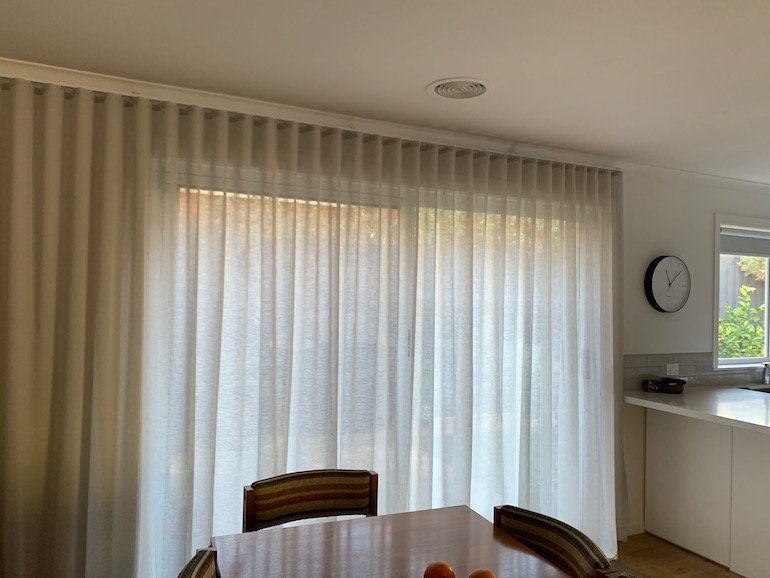
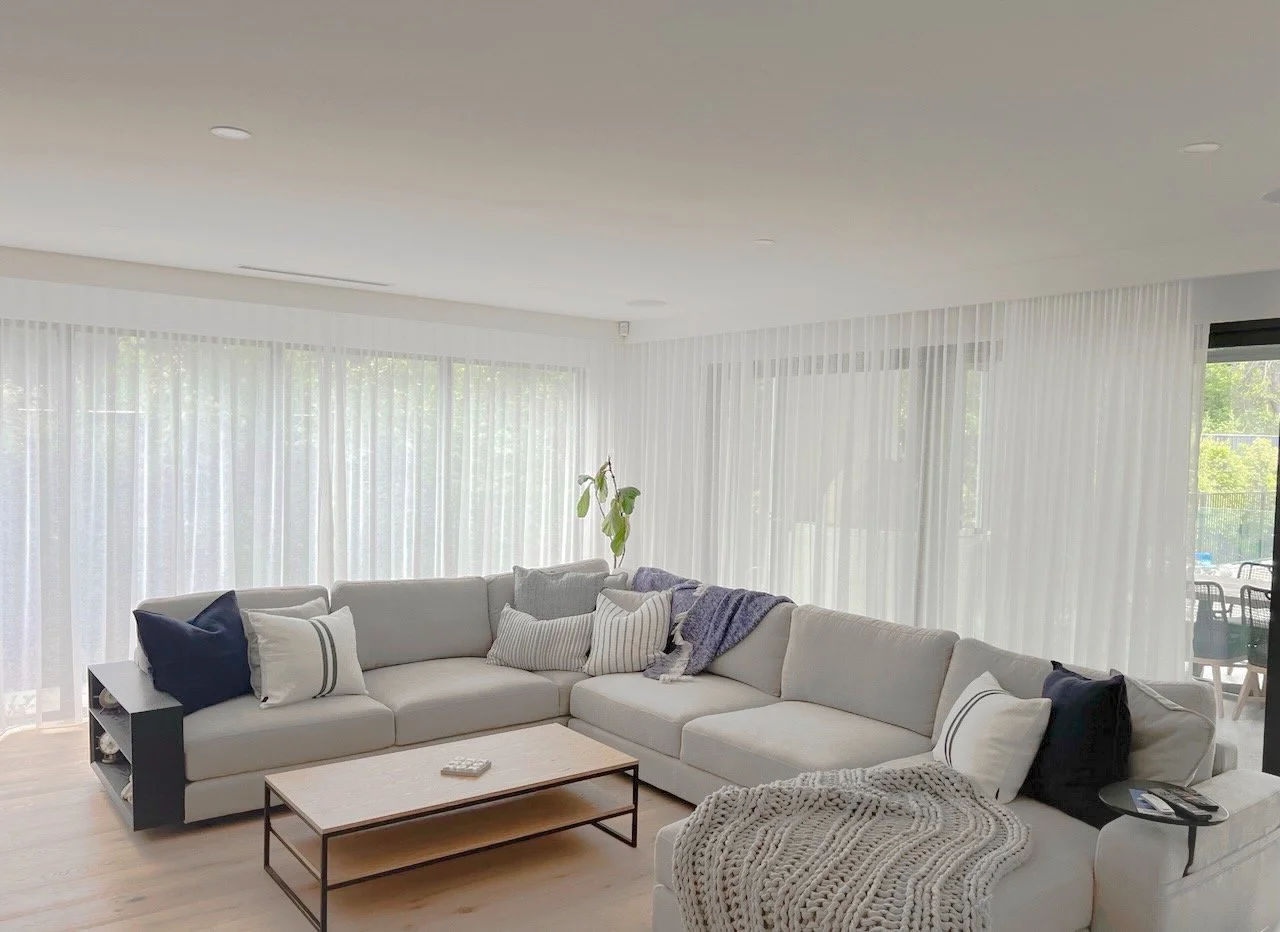
The image above shows an S-Fold header, sometimes also referred to as a wave fold. This requires a special header tape to be fitted at the top of the curtain, and utilises a specific track to create beautiful flowing curves. We can advise you on the most appropriate header options for your curtains, based on the style and look you want to achieve.
-
Traditionally curtains open in the middle of the window, and slide back to their respective ends. This is called a 2 way draw, or centre part.
A one way draw means the full curtain slides back in one direction only, either to the left or right. This enables a single curtain to flow across the full opening, providing a seemless finish. However a one way draw, results in the full amount of the curtain needing to stack on one side of the window, which can appear unbalanced, or block too much of the window if not correctly fitted.
We look beyond the dimensions of the window when identifying the best way to stack a curtain, so that our recommendation will always maximise the light and space available.
-
Although a track has a very speficic function to achieve, where it is fitted can have an impact on the overall appearance of the finished curtain and the look achieved.
Curtain tracks are usually fitted to the wall at a certain height above the window being dressed. When assessing this height though, it is important to check around the room for any structural or decorative elements which may need to visually line up with the track height. Likewise there may already be other window coverings in the room which will need to tie in.
Fitting a track to the ceiling creates a sense of drama and gives the effect of increasing the ceiling height by elongating the wall. This is currently one of the fastest growing trends.
-
This is an important aspect which can easily be overlooked in the desire to achieve aesthetic perfection. Long flowing sheers look beautiful, but in a play room used by toddlers – probably not the best choice ! Similarly a roman blind made with a designer fabric – probably not an ideal choice for a kitchen sink area.
We will discuss with you how the room is used, and who uses it, so that we can fully assess the need for light control, privacy, durability, cleanability and of course we still want it look wonderful!
-
Do you have a dog that likes to look out of the front window ? How about a cat that likes to climb curtains ? We’ve even had a customer with a rabbit running around the house.
As pet owners ourselves (2 whippets, 1 cat and a blue tongue lizard at the last count) we understand that pets are an integral part of the family. So we will take the time to discuss your furry friends with you, and see if there are any particular habits that we need to consider when making our recommendations.
Custom curtains represent an investment in your home that should last for many years. So get in touch with the experts and let our experienced team guide you through the process.
Custom curtains represent an investment in your home that should last for many years. So get in touch with the experts and let our experienced team guide you through the process.
-
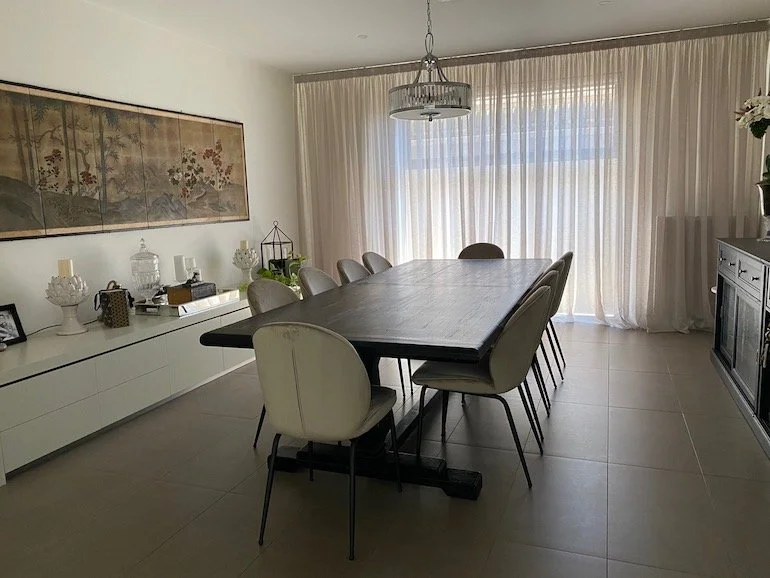
![A dining room with a large wooden table surrounded by white upholstered chairs, a white sideboard with decorative items, and a window with sheer curtains letting in natural light.]()
“Samantha and David were a delight to work with and greatly assisted us with new curtains and blinds for our renovated home. They are professional, friendly, highly experienced, and always went the extra mile without a blink. I would highly recommend them.”
— Kate S, Dingley Village.
-
![Dining area with a wooden table and striped chairs, large sheer curtains closing a window and door, a wall clock, and part of a kitchen with a small window and countertop.]()
“Very satisfied with the service we received from Sam and David of Evans Curtains and Blinds. From the intial measuring up and quote, to the installation of the curtains, the service and expertise was excellent. We are pleased with the finished product and have no hesitation in recommending this company.”
— Gladys W, Beaumaris.
-
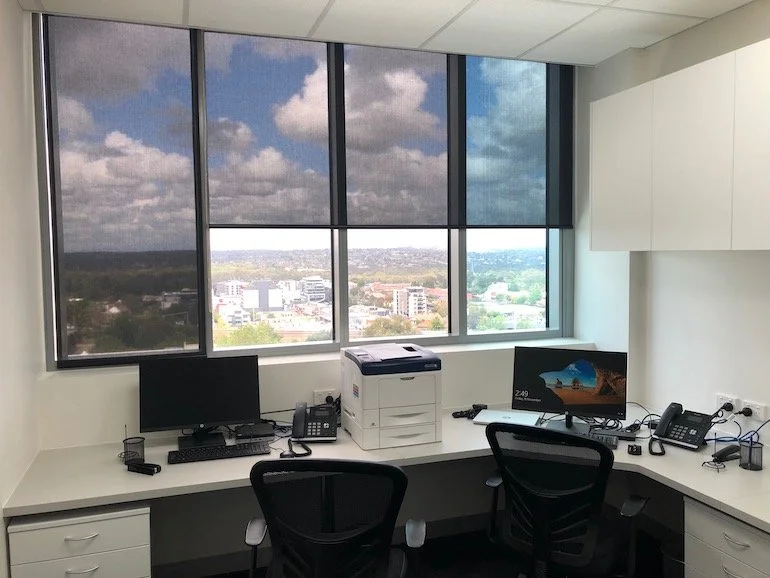
![Office workspace with two desks and chairs, two computer monitors, a printer, landline phones, and city view through large windows.]()
“Quality products, helpful staff and very reasonably priced. Evans Curtains and Blinds have been installing products at our hospital for 5 years +. Highly recommended.”
— Andrew C, Heidelberg.
-
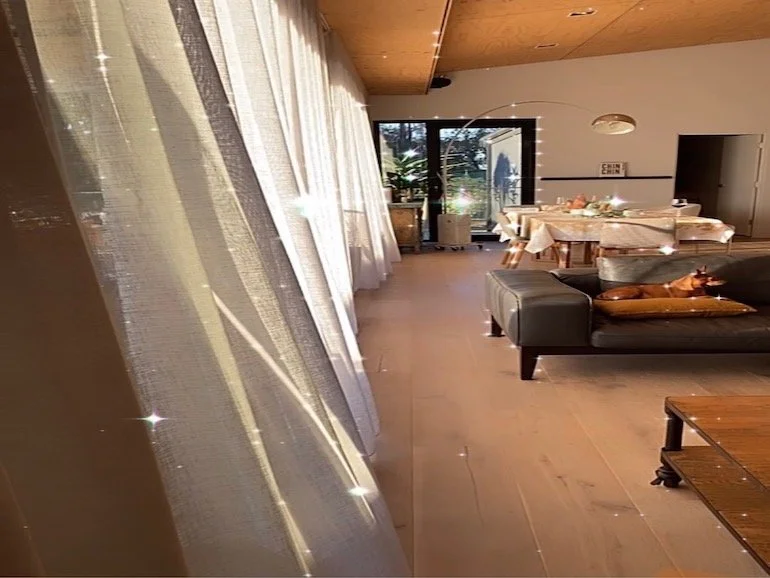
![Living room and dining area with curtains, a black sofa, a wooden coffee table, a round dining table with chairs, and a sliding glass door leading outside.]()
“Highly recommend. Quality products with a large selection to choose from. They even recommended an app for remote control which works amazingly. Ordering was easy, in fact the whole process was easy.”
Catherine B, Mount Eliza.
-
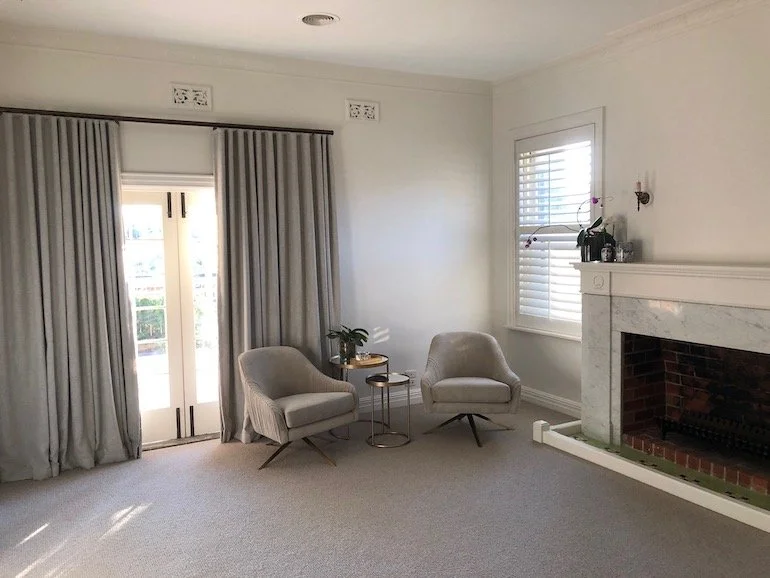
![A living room with light-colored walls and carpet, two beige armchairs with matching upholstery, a small round side table between them with a plant, a window with shutters, and a corner fireplace with a white mantel and marble surround.]()
“Absolutely love my new blinds and sheers! Super happy with Evans Curtains and Blinds and would highly recommend them. They offer fantastic service and amazing quality products. They were so helpful throughout the process 10/10 would definitely use again. Thank you so much.”
Charlotte W, Frankston South.
-
![Living room with large white sectional sofa, pillows, and throws, light wood floor, sheer white curtains on windows, and a small coffee table.]()
“Samantha and David were a delight to work with and greatly assisted us with new curtains and blinds for our renovated home. They are professional, friendly, highly experienced, and always went the extra mile without a blink. I would highly recommend them.”
Mel R, Mount Eliza.
CONTACT
Get in touch
Looking for ideas and advice on Curtains?
Click below to fill in the form and we will be in contact soon.